
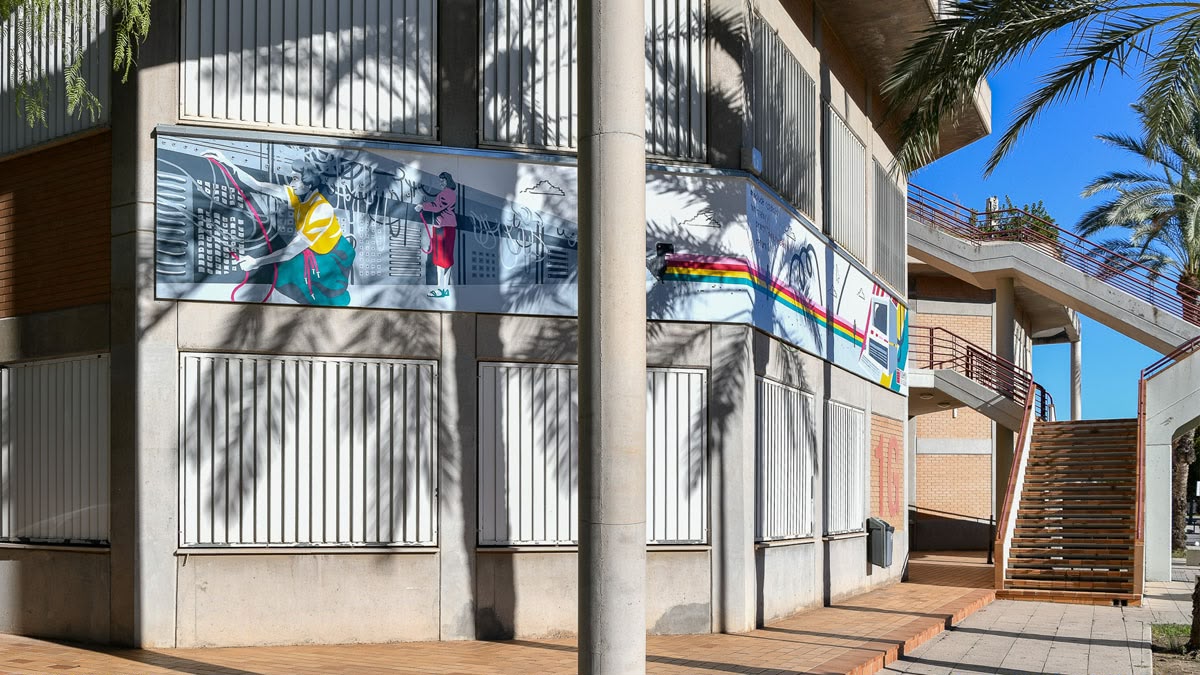
The east facade of the 1G building at the School of Computer Science and Engineering of the Universitat Politècnica de València (UPV) features a mural approximately 15 meters long that traces the evolution of computing. Conceived to raise the profile of the Computer Museum, the work transforms the building’s entrance into a space for cultural and technological outreach, inviting those passing through the campus to discover the heritage preserved by the museum.
The project emerged from a collaboration between the Computer Museum and the San Carlos Faculty of Fine Arts at the UPV. A proposal submitted by Alba Granell Mateo—a student in the UPV’s Master’s program in Artistic Production—was selected, and the mural was subsequently executed by a team of five Fine Arts students. The initiative was developed as part of the “Painting and Environment” course, taught by professors Juan Canales and Álvaro Porras. As a starting point, the students visited the Computer Museum, where they explored its collections and drew inspiration from its technological artifacts to develop their artistic proposal.
The central theme of the composition is the historical evolution of computing. The mural offers a visual journey from left to right, beginning with large-scale computing equipment operated by women and progressing toward the integration of computers into the home. Notable elements include the depiction of an IBM system, which helps evoke the various stages of technological development.
Beyond its artistic merit, the work aims to bring the history of computing closer to the public, illustrating how hardware has evolved—transitioning from large, specialized installations to the everyday tools we use today. At the same time, the project highlights the contributions of women to the development of computing, integrating them into the historical narrative of the field.
Furthermore, the mural serves as an example of collaboration across different academic disciplines within the UPV. The fusion of art, history, and technology transforms the façade into a visual and educational resource that reinforces the identity of the Museum of Informatics and establishes a link between the technological heritage of the past and the training of new generations of professionals.
